Bandura — API testing IDE
The graph and the code are the same file.
Bandura is a local-first IDE for API testing: no account, no forced cloud, fully
offline. Every flow is a plain-YAML .aether file in your own Git repo —
a visual graph you can arrange by hand and a code editor you can be exact
in, over one source of truth. AI with your own key, never credits.
v1.0.0 in development — 138 end-to-end tests passing · launching soon
One file, two hands
Not an export. Not a sync. Two renderings of one file.
Postman Flows gives you a graph and hides the code. Bruno gives you code and has no
graph. Bandura refuses the choice: the graph view and the code view are the same
.aether YAML, edited either way, always in agreement — because there is
nothing to keep in agreement. Visual enough for manual QA to model a scenario;
exact enough for automation engineers to own every step — one Git-reviewable file
for the whole team.
- id: login
type: request
config:
method: POST
url: ${{ variables.baseUrl }}/auth/login
body: |
{ "email": "${{ env.DEMO_EMAIL }}", "password": "${{ env.DEMO_PASSWORD }}" }
capture:
accessToken: response.body.token # every later node can read this
next: get_product Plain YAML with embedded JavaScript. Human-readable, diffable, and — because it's just text — something an AI assistant can actually read and reason about.
Runs like an IDE
Watch it run. Then ask any node what actually happened.
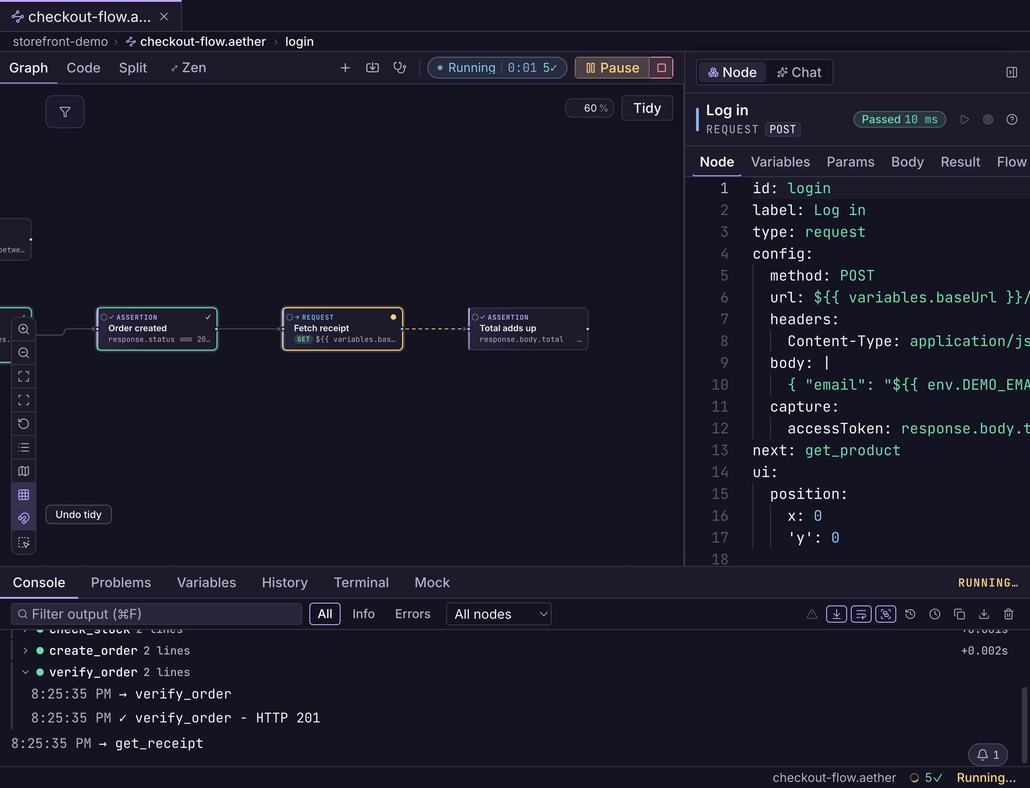
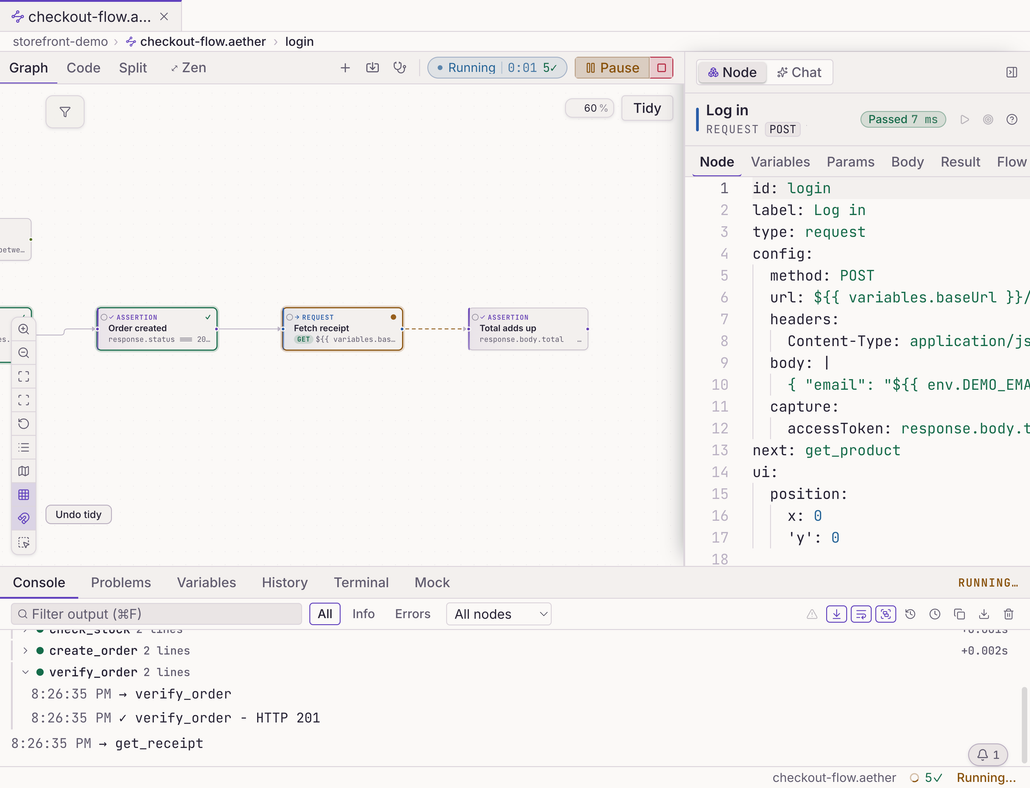
A run lights the graph node by node — passed, failed, branching live. Click any node
for its resolved request and response: not the template, the real
thing that went over the wire, headers and all. Values captured by one node
(capture: accessToken) are visible everywhere they're used.
And before a run: unresolved references get a ⚠ on the node and a
banner — Bandura asks before running blind, instead of failing three nodes deep
with a silent undefined.
Git-native by construction
Sharing a test suite is git clone.
There is no workspace invite, no export, no import — a Bandura project is a folder of plain-text files, so it was already in your repo. Your teammate clones it and runs.
-
git clone … && open the folderBandura recognizes the project from
bandura.jsonand the.aetherfiles. Nothing to convert. -
fill in the two env vars it asks forThe manifest declares required variable names — never values. Secrets go to a git-ignored
.env, or the OS keychain. They never touch the format. -
▶ RunUnder a minute from clone to a green graph. That's the whole onboarding.
Review API tests like code — because they are
- id: create_order
type: request
config:
method: POST
- url: ${{ variables.baseUrl }}/order
+ url: ${{ variables.baseUrl }}/orders
capture:
+ orderId: response.body.id
An .aether change in a pull request: reviewable line by line, blameable,
revertable. Try that with a database-backed collection.
Terminal & CI
The same engine runs everywhere the work happens.
The desktop app, the CLI, and the MCP server share one execution engine. A flow that passes on your machine passes identically in CI — it's the same code running the same file.
Available at launch
# Installs a self-contained native binary — no runtime to load
npm install -g @bandura/cli
bandura --version
# ...or run without installing
npx @bandura/cli run
A native binary per platform — macOS (Apple Silicon & Intel), Linux
(x64/arm64, glibc & musl), and Windows x64.
No account, no backend. Join early access for the launch-day
install, or read the CLI reference →
Exit code 0 on green, non-zero on any failure — the CI contract. Reporters:
pretty, JSON, JUnit XML, GitHub annotations. Run a file, a glob, or a named suite:
bandura run --collection smoke runs an ordered collection as one report.
# .github/workflows/api-tests.yml — generated by "Export to CI/CD"
- uses: bandura-io/run@v1
with:
flows: "flows/**/*.aether"
env:
BASE_URL: ${{ secrets.STAGING_URL }}
The CLI, the official GitHub Action, and in-app CI/CD export are all shipped
today. Secrets flow in as environment variables — the same
.env contract as local runs.
AI as an instrument
AI that plays with you, not at you.
Bring your own Anthropic key: your cost, your data, no credit meter, nothing metered behind your back. And because flows are plain text, the AI — yours or your editor's — gets full-fidelity context, not a proprietary blob.
Your agent can run the whole loop
The Bandura MCP server exposes your workspace to Claude Code, Claude Desktop, or Cursor as structured tools. An agent lists your flows, runs one, reads the failing node's request and response, edits the YAML — it's just a file in your repo — and re-runs. No GUI round-trip, no screen scraping. And it runs where your files are: a local stdio process, not a vendor cloud relay — the agent's view of your flows, tokens, and responses never transits anyone's servers. (Postman's own State of the API 2025: 51% of developers worry about AI agents' unauthorized access to their APIs; 46% fear credential leakage. Locality is the fix, not a policy promise.)
The rest of the workbench
Small things that make it feel like an IDE, because it is one.
Command palette
⌘⇧P for every command, ⌘P-style search across commands
and files. VS Code-style keyboard shortcuts throughout — hands stay on the keys.
Eight node types
request assertion condition loop parallel script ai-action subflow — branch, iterate, fan out, compute, compose flows from flows.
Real terminal, built in
A full terminal in the bottom panel, opened in your workspace — run
git, curl, or the bandura CLI without
leaving the window.
Run history
Every execution persisted locally (SQLite) — durations, per-node results, what changed between runs. Local means local: history never leaves your machine.
Flow Map
A workspace-level view of how flows connect through subflows — watch a parent run light up its children live.
Plays well with other editors
Edit an open file in VS Code or pull from Git and Bandura notices — clean files reload silently, dirty ones get an honest reload-or-keep choice. It's your file, not the app's.
Data-driven runs
Attach a CSV or JSON dataset (or inline rows) and the flow runs once per row, the
row in scope as data. Each row is an independent test case — a
capture in one never leaks into the next — with a per-row pass/fail
tally at the end.
Start from a template
New from template drops in a ready-to-run flow — smoke test, auth chain, CRUD, pagination, poll-until, data-driven. Each one runs against a public sandbox on the first try, so you learn the format by running it, not reading about it.
From the current build
Screenshots of the app as it is today.
Everything below is captured from the real desktop app — the same build the end-to-end suite runs against. No mockups, no repaints: what you see here is what early birds get on launch day.
Graph editor
Model the scenario the way you'd whiteboard it.
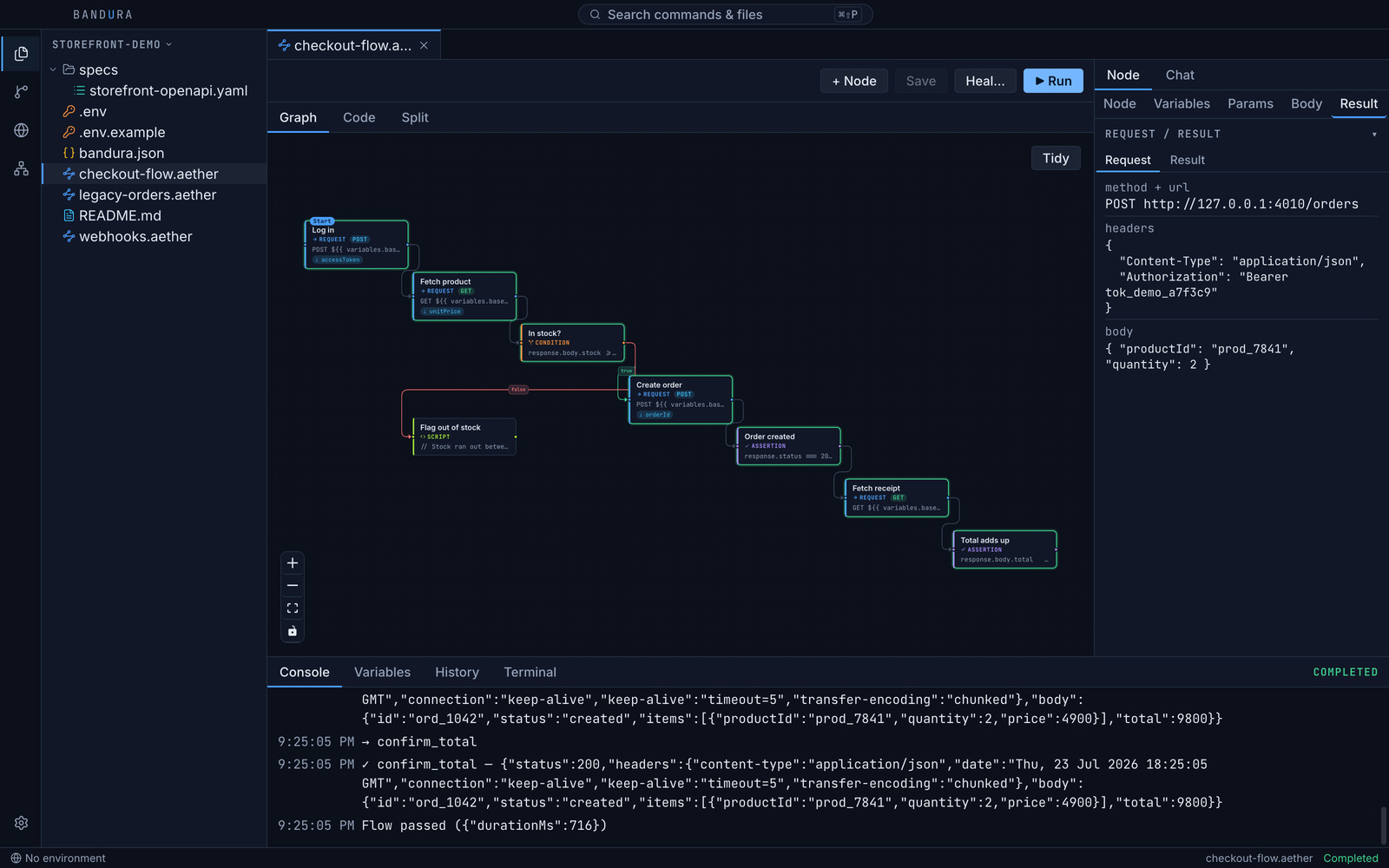
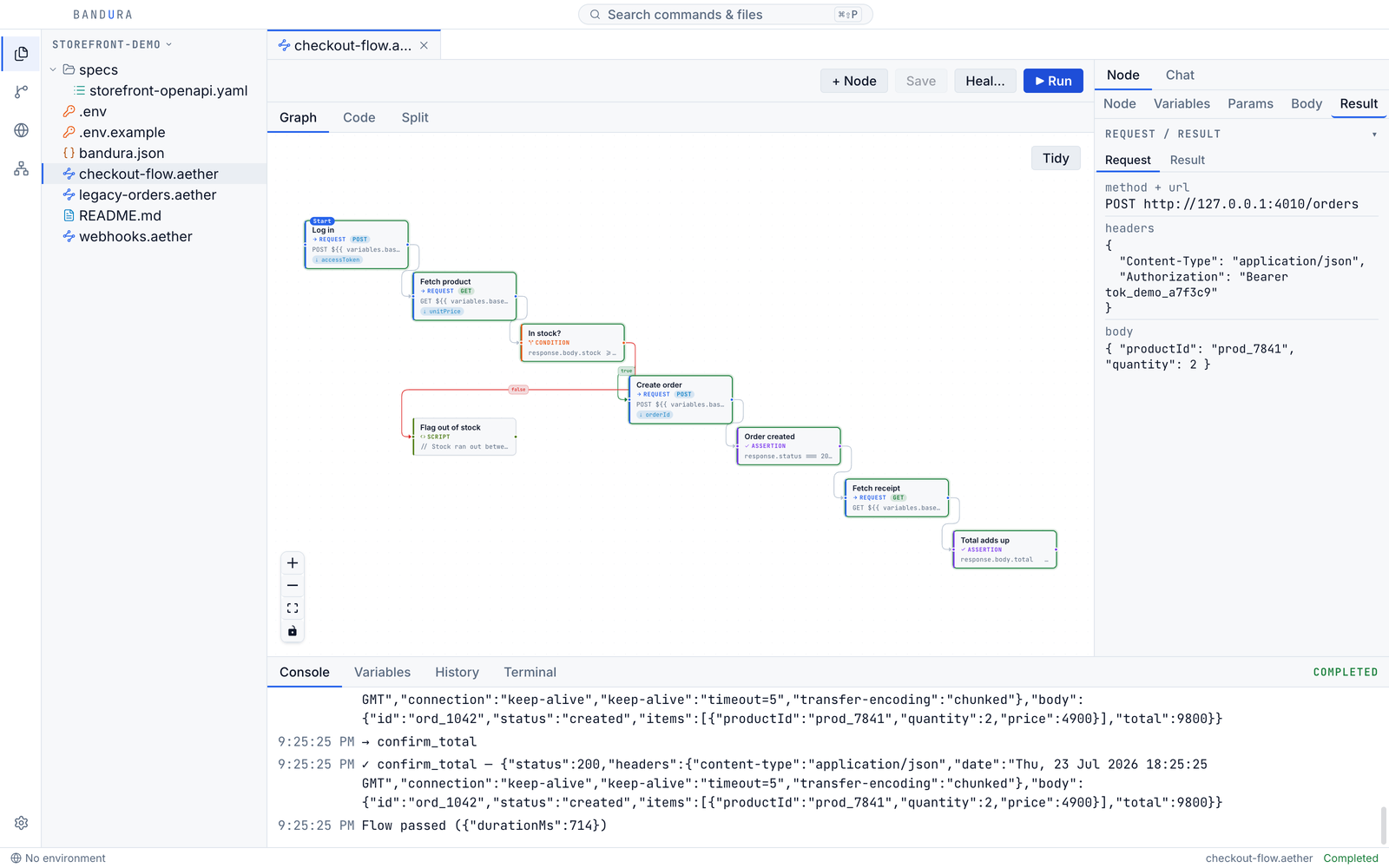
Login, capture the token, spend it downstream — the graph is the test. Arrange nodes by hand for the manual-QA view; every one of them is still real, editable code underneath.
Execution
Runs you can watch, then interrogate.
Nodes light up as they pass or fail, the console keeps the line-by-line record, and any node will show you the exact resolved request and response it produced.
Code view
The same flow, as the YAML it actually is.
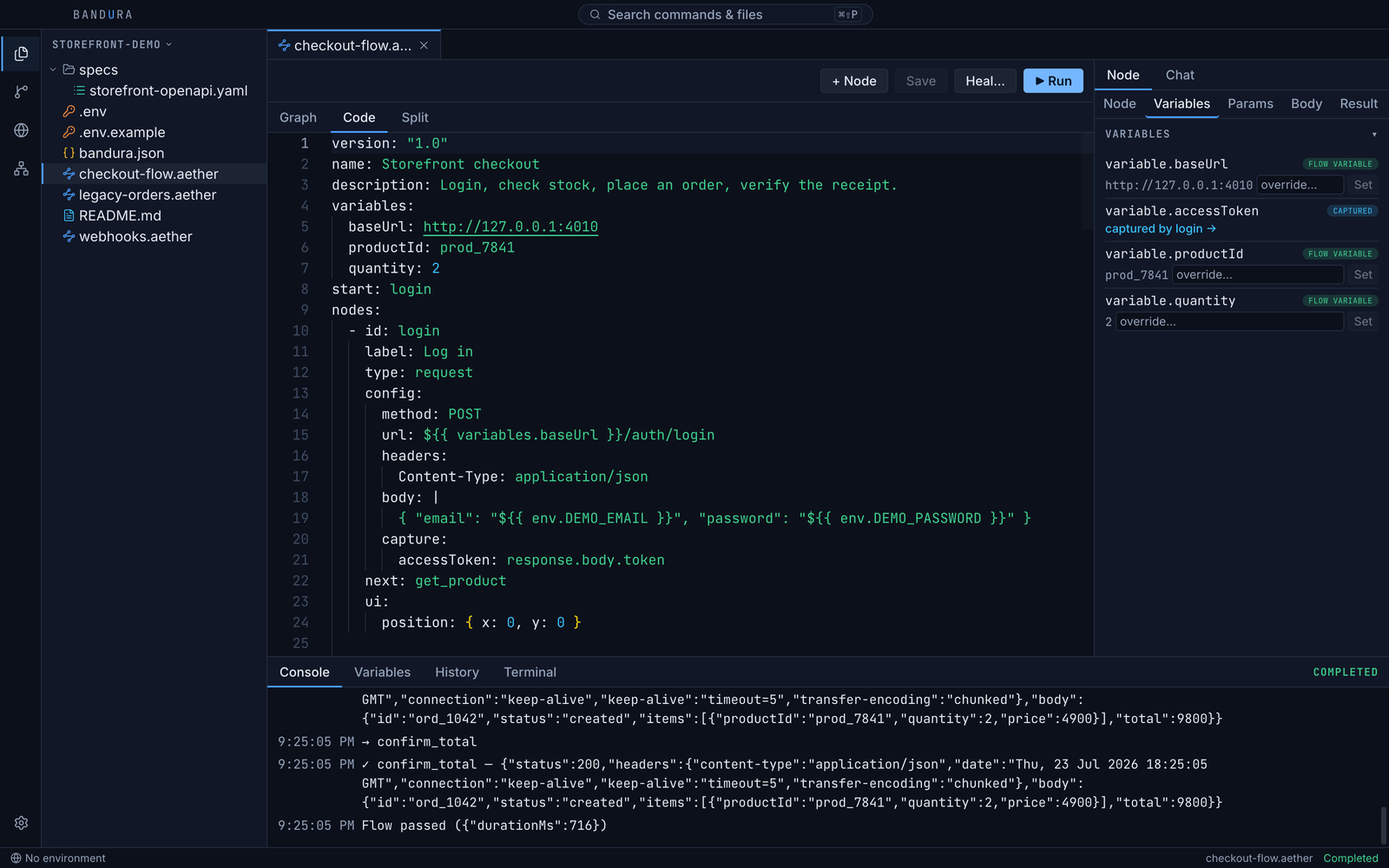
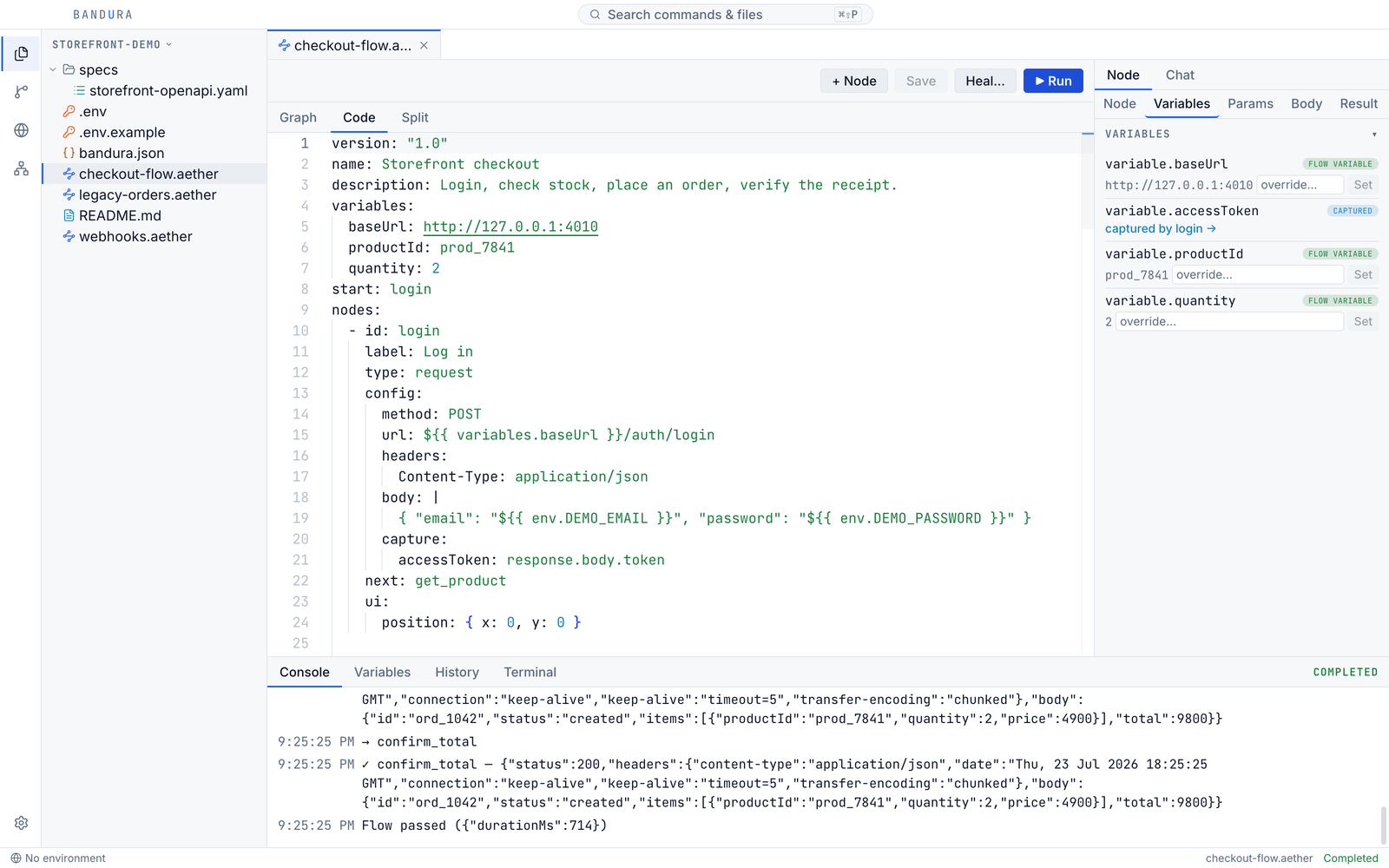
Switch tabs and the graph becomes text — not an export, the file itself. Edit either rendering; there is no second copy to fall out of sync.
Self-healing
Drift found deterministically — offline.
Point a flow at your OpenAPI spec: renamed paths, changed methods, and new required fields are detected by comparison, not by a cloud LLM. No AI key, no data egress, one-click fixes.
Variables
Every value, with its provenance.
Flow defaults, .env values, and everything captured mid-run — each variable shows where it came from, and unset references are flagged before the run, not three nodes into it.
Import
Your collections come with you.
Paste a Postman collection, an OpenAPI or Swagger spec, a Bruno request, or a curl command — the format is auto-detected and converted to .aether files in your repo.
Compared, honestly
Where Bandura stands — as of July 2026.
| Bandura | Postman | Bruno | Insomnia | Apidog | |
|---|---|---|---|---|---|
| Plain-text, Git-native format | ✓ YAML in your repo | ✗ cloud workspace | ✓ .bru files | partial — Git sync | partial — Git sync |
| Visual multi-step flow graph | ✓ | Flows — no code view | ✗ | ✗ | scenario steps |
| Code-level editing of every step | ✓ same file as the graph | not in Flows | ✓ | ✓ | ✓ |
| Works offline, no account required | ✓ | ✗ account + sync | ✓ | local Vault, but Kong account gates most features | 4-user free cloud tier |
| AI pricing model | BYO key — no credits | credit economy | — | BYO LLM | bundled quota |
| Self-healing against OpenAPI drift | ✓ deterministic, offline | ✗ | ✗ | ✗ | spec-driven regen |
| Retry & poll-until on any step | ✓ declarative in YAML | ✗ script loops only | ✗ script loops only | ✗ script loops only | per-step on-error only |
| MCP server for AI agents | ✓ shipped, local — no cloud relay | ✓ | ✗ | ✗ | ✓ |
| Headless CLI for CI | ✓ shipped, incl. GitHub Action | Newman/CLI | ✓ | ✓ | ✓ |
| Protocols beyond REST | REST, GraphQL, gRPC, WebSocket | ✓ | GraphQL, gRPC | ✓ broad | ✓ broad |
| What it costs | Free; $59 once per seat for commercial use — 12 months of updates, and the build you have keeps working | $9 / $19 / $29 / $49 per user/mo | $6 / $11 per user/mo | $12 / $45 per user/mo | $9 / $18 / $27 per user/mo |
When Postman is still the right call: if you need protocols Bandura doesn't speak yet (SSE, MQTT, SOAP), a hosted team workspace with real-time collaboration, or a large built-in monitoring/mock cloud, the incumbents are further along. Bandura's bet is the opposite one — a local-first, Git-native, plain-text tool that does the API-testing job exceptionally and stays out of your cloud. If that trade is yours to make, keep reading.
Import is one click for Postman collections and environments, OpenAPI/Swagger specs, Insomnia exports, Bruno requests, and curl commands — shipped today. Competitor details from our July 2026 review of public pricing and docs; corrections welcome at [email protected].
Where it fits
Six jobs Bandura is built for.
Migrating
Leave Postman without losing your collections
One-click import turns collections into plain files in your repo. No seat pricing surprise can follow you into your own Git history.
CI
API regression tests in your pipeline
bandura run over a folder of flows: exit codes, JUnit output, GitHub
annotations. Replace the brittle Newman setup with files your team can review.
Sharing
Onboard a teammate with a clone
Ship runnable API examples with your repo. The manifest asks for the env vars it needs; a minute later they're watching the graph go green.
Agents
Let your AI agent fix the failing test
Via MCP, an agent runs a flow, reads the failing node's real request and response, edits the YAML, and re-runs. The whole loop, no GUI.
Debugging
Untangle a multi-step auth chain
Login, capture the token, chain authorized calls — then click any node to see the exact resolved request it sent. No more copy-pasting bearer tokens.
Maintenance
Keep tests honest against a moving API
Teams report 60–80% of testing time going to maintaining brittle tests, not writing them. Point a flow at the current OpenAPI spec; apply the drift fixes — deterministically, offline; re-run.
In the open
What's shipped, what's next, what's later.
No dates, no vaporware: everything on this page marked shipped is in the app today, and everything that isn't says so.
Shipped
- Desktop IDE — graph + code editor over
.aether, 10 node types - Execution engine with per-node request/response inspection & history
- Retry & poll-until on any step — declarative in the YAML, not script loops
- Data-driven runs — one flow, once per CSV/JSON row, each row independent
- GraphQL requests — same request node, same engine in desktop, CLI, and MCP
- gRPC nodes — unary & server-streaming, via
.protoor server reflection - WebSocket nodes — connect, send, collect messages, close
- Import: Postman collections & environments, OpenAPI/Swagger, Insomnia, Bruno, curl
- Natural-language flow generation (BYO key)
- Self-healing vs OpenAPI drift — deterministic, offline
- Headless CLI — pretty/JSON/JUnit/GitHub reporters
- Collections — an ordered suite as one report, from the CLI (
bandura run --collection) and a workspace sidebar view - Flow template gallery — one-click starter flows that run on the first try
- MCP server: list, read, run, drift-check, import
- Clone → run onboarding: manifest recognition + env prompt
- GitHub Action + in-app CI/CD export
- User docs — the help center is live now
Next
- Signed installers for macOS / Windows / Linux — v1.0 launch
- More protocols — SSE, MQTT, SOAP — order set by early-user demand
Later
- Scheduled monitors & remote execution
- Web app
- Team workspaces (hosted collaboration)
- Mock server generator
- HAR importer
Pricing
Free to download. $59 once, if it earns you money.
The download is the whole app — not a trial, not a community edition, not a version with the good parts removed. Personal projects, learning and open source are free indefinitely. Using it at work? Thirty days to evaluate it properly, then buy a seat: one payment, twelve months of new releases, and the version you have keeps working after that. Nothing is ever switched off; the commitments below are the part we put in writing.
- Local functionality is free, forever. Saving, editing, and running local flows will never move behind a paywall — licence or no licence.
- Git collaboration is free by construction. Sharing via a repo is just Git. We will never charge for your own version control.
- No AI credit economy. Bring your own key — free and unmetered at our layer. Hosted AI, when it comes, is a flat per-seat inclusion.
- No forced account, even after you buy. Your key is verified offline against a public key inside the app. There is no server to log into, and no server that can be switched off to disable software you paid for.
- No "lifetime" promises. A licence covers twelve months of new releases, stated up front, and the build you have goes on working after that. That window is the only boundary — whatever we ship inside it is yours, major versions included. Vendors who promised "everything, forever" for one payment have all had to take it back. We would rather commit to less and keep it.
- Nothing is ever switched off. The 30 days are how long we stay quiet, not how long the app works. Day 31 is exactly as capable as day 1 — no read-only mode, nothing that runs out, no feature that a licence unlocks. The end of an update window works the same way: the copy you have carries on unchanged.
Download
$0
- The complete desktop IDE, unlimited flows
- All importers, CLI, MCP server
- AI features with your own key
- No account, no telemetry, works offline
Free indefinitely for personal work, learning and open source — not a trial, and nothing expires. See the downloads →
Licence — for commercial use
$59 once, per seat · 30 days to decide
- Every release we build in the next 12 months
- That version then runs unchanged for good — renewing is optional
- New releases and betas before they're public
- Your bug reports answered first
- Verified offline; keeps working if we don't
Buying unlocks nothing, because nothing is locked. The licence terms give you 30 days to evaluate Bandura at work, and after that a dismissible note — once a day at most — is all that ever mentions it. Running a build from outside your 12 months without renewing brings back that same note, and nothing else.
Licences open at launchHosted — later
post-1.0
- Web access, remote & scheduled runs
- Hosted AI (flat, no credits)
- Team workspaces, shared history
Subscription, because it genuinely runs on servers we pay for. Nothing that runs on your own machine will ever move here.
Buying opens at the v1.0 launch. Until then the app isn't downloadable and there's nothing to pay for — join the early-access list below for the launch-day link and a founding-user badge.
Why "Bandura"
Named after an instrument you play with both hands.
The bandura is a Ukrainian string instrument — a lute's fretted neck and a zither's
open strings fused over one soundboard. One instrument, two ways of playing, every
string tied to the same resonant board. That's the product in one image: the graph and
the code are two hands on the same strings, and the .aether file is the
soundboard underneath.
Questions, answered straight
FAQ
Can I download Bandura today?
Not yet — the desktop app is in active development toward its v1.0.0 launch, with 138 end-to-end tests passing against the current build. The /download page lists exactly what ships and on which platforms: macOS (Apple Silicon and Intel), Windows, and Linux, each built natively on its own machine. Joining the early-access list gets you the launch-day download link first and a founding-user badge.
Is Bandura free?
The download is the complete app — nothing locked, timed, or degraded — and it is free indefinitely for personal projects, learning, and open-source work. Using it at your job is what a licence is for: 30 days to evaluate it, then $59 once, per seat, covering every release we build in the following 12 months. It is not a subscription, and after those 12 months the version you have keeps working. Unlimited flows, all importers, the CLI, the MCP server, and AI features with your own key are in the free download either way.
What happens after the 30 days if I don't buy a licence?
The app carries on exactly as before. Nothing is disabled, degraded, or made read-only — not at day 31, not ever. What changes is that it starts showing a dismissible note, at most once a day, asking you to buy a seat if you're using it commercially. That is the entire enforcement mechanism. We would rather ask honestly than build a tool that holds your own work hostage, and the end-to-end test suite pins that down: one of the tests exists purely to prove an unlicensed, past-30-days install still runs flows.
Is the licence a subscription?
No. One payment of $59 per seat — nothing auto-renews, and no card is kept on file. What the payment covers is every release we build in the 12 months after you buy: every bug fix and every feature that lands in that window is yours. Builds we make after your window need a renewal, and renewing is optional and costs less than the first purchase; we'll publish the exact renewal price well before anyone's first 12 months are up. The window is the only boundary: if version 2.0 lands while yours is open, you get it — there is no separate upgrade fee to work out. We call this perpetual rather than 'lifetime' because there is a real boundary and we would rather tell you where it is.
What happens when the 12 months of updates run out?
The version you have keeps working, unchanged, forever. It does not expire, go read-only, phone home, or lose a feature — the boundary is on new builds, never on the software you already run. If you do install a release built after your window without renewing, the only thing that happens is the same dismissible note, at most once a day, comes back. Nothing else changes. Renewing is optional, and the app never asks for a card. Verification stays offline throughout: your key is checked on your own machine against a public key built into the app, with no server involved, so it keeps working even if we disappear.
What do I actually get for the $59?
Permission to use Bandura commercially, every release we build in the following 12 months, and three things that are worth having on their own: new releases and beta builds reach licence holders before they go public, your bug reports and feature requests get answered first by the person who wrote the code, and you can be credited in the release notes if you want to be. Plus the note stops appearing.
Is Bandura a Postman alternative?
Yes — that's the most common migration. Unlike Postman, Bandura needs no account and no cloud sync: your API tests are plain-text .aether files in your own Git repository. One-click import for Postman Collection v2.1 is shipped, so your existing collections come with you.
Is Bandura open source?
Not today. But there is no lock-in by design: the .aether format is plain YAML in your repo, readable and editable by any tool, and the format is documented. Your tests never live in our database — they live in your Git history.
What is an .aether file?
One flow: an ordered, branching set of nodes (request, assertion, condition, loop, parallel, script, AI action, subflow) written as plain YAML with embedded JavaScript expressions. The visual graph and the code editor are two renderings of that one file — routing lives on each node, so there's no separate graph state to drift out of sync.
Does Bandura work offline?
Fully. Editing, running, importing, drift detection, the CLI — all local, no account, no network required. Only the AI generation and chat features call out, using your own Anthropic key.
Can I import Postman collections, OpenAPI specs, or curl commands?
Yes, all shipped: Postman Collection v2.1 (folders flattened, variables and auth carried over), OpenAPI 3.0/3.1 and Swagger 2.0, pasted curl commands, Bruno requests (.bru and OpenCollection YAML), Insomnia v4 (JSON) exports, and Postman environment files (imported as .env values).
What platforms does it run on?
macOS (Apple Silicon and Intel), Windows, and Linux (AppImage and .deb). Every installer is built natively on its own platform, so nothing is cross-compiled. The first releases are unsigned while the Apple and Windows certificates are being obtained, which means macOS asks you to right-click → Open the first time and Windows shows a SmartScreen prompt; both are expected, and we would rather say so than have you discover it. Signing lands shortly after launch.
Does it support GraphQL, gRPC, or WebSocket?
All three are shipped. GraphQL rides the request node (a graphql block with query, variables, operationName), with GraphQL errors failing the node loudly instead of hiding behind an HTTP 200. gRPC is its own node type — unary and server-streaming, via a .proto file or server reflection. WebSocket is a node too — connect, send, collect messages, close. Every one runs identically in the desktop app, the CLI, and the MCP server. SSE and MQTT are the next protocols on the roadmap.
What does the AI cost?
Whatever your Anthropic key costs you — Bandura adds no markup, no credits, no metering. And most of the intelligence doesn't need a key at all: import, drift detection, and self-healing fixes are deterministic and run offline.
How do I run API tests in CI?
The bandura CLI runs any flow or glob headlessly and exits non-zero on failure — the standard CI contract. Reporters: pretty for terminals, JSON, JUnit XML for test history, and GitHub annotations. An official GitHub Action and in-app CI/CD export are shipped too. You can also run a named suite in one shot: bandura run --collection smoke executes an ordered collection defined in bandura.json and reports it as one result.
Can I run one flow against many rows of test data?
Yes — attach a CSV or JSON dataset (or inline rows) to a flow and it runs once per row, with that row in scope as `data` (use it in any URL, header, body, or assertion). Each row is an independent test case: a value captured in one row never leaks into the next, and the run reports a per-row passed/failed tally. It runs the same in the desktop app and the CLI, so it works in CI too.
v1.0.0 in development — launching soon
Be there on launch day.
Early birds get the launch-day download link, a founding-user badge, and the extended trial we promised when the hosted tier ships. Until then: one or two emails, nothing else.